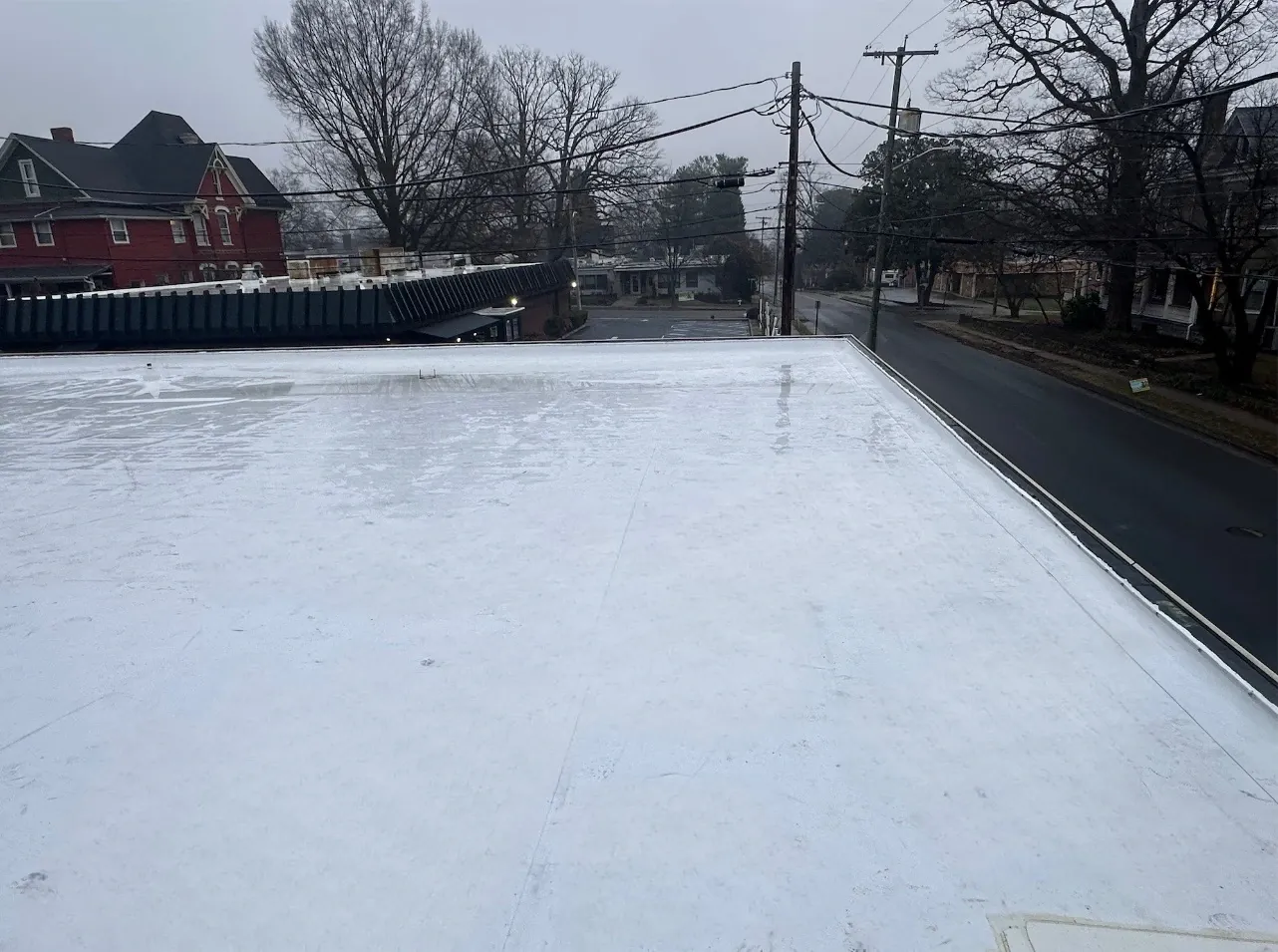
If you run a building in Spartanburg, a roof problem is never just a roof problem. It's buckets in the hallway, a section roped off, and inventory you've got to drag out of the way before it gets soaked. Most commercial roofs around here are flat or low-slope, and those don't fail the loud, obvious way a steep shingle roof does. The leak shows up nowhere near the actual hole. The damage spreads under the membrane where you can't see a thing. And by the time a ceiling tile finally lets go, the fix is a lot bigger than it had any business being. We repair commercial and low-slope roofs all over Spartanburg and the towns around it. The goal never changes: find where the water's really getting in, fix it right, and keep your doors open while we do.
Signs your commercial roof needs attention
You don't have to climb up top to catch most of this. Honestly, a walk through the building and one good look after the next hard rain will tell you plenty.
- Water stains, drips, or ceiling tiles going soft on the inside
- Standing water that's still sitting up there a day or two after it rained
- Seams lifting, curling, or pulling apart
- Cracked, blistered, or bubbled patches across the membrane
- Flashing around the curbs, vents, and rooftop units that's gone loose or rusty
- Drains and scuppers running slow or backing up
- Heating and cooling bills creeping up for no reason, which can mean the insulation's already wet underneath
One of these on its own is worth a look. Two or three together, and water's usually found its way in already.
Commercial systems we repair
Flat and low-slope roofs are their own animal, and how we fix one depends a lot on what's already up there. We work on what you actually find on Spartanburg buildings: TPO and EPDM single-ply, modified bitumen, the old built-up gravel roofs, and metal, whether that's standing-seam or exposed-fastener. If yours is a true flat roof, our flat roof repair page gets deeper into membrane patching and seam work. If you're looking at a full overhaul or a brand-new system, that's over on our commercial roofing page. This one's about the targeted repair that keeps a roof that's still got life in it doing its job a few more years.

What usually goes wrong up there
Low-slope roofs almost never go all at once. They give out at the weak spots, and the weak spots are pretty predictable. Ponding is the big one. Water that can't drain just sits in a low spot, bakes in the sun, and slowly eats whatever's under it. Seams are next, since that's where two sheets of membrane got joined and where age pulls them back apart. Then there's the flashing around everything that pokes through the roof, your HVAC curbs, vents, and drains, and you'd be surprised how many commercial leaks actually start right there. Toss in the odd puncture from foot traffic or a dropped tool and that's most of them. Why's it matter to you? Simple. A little seam repair caught early is a quick, cheap visit. That same seam ignored for a year soaks the insulation and turns into a deck you've got to tear out.
Repair or replace? How we help you decide
Not every leak means a new roof, and a roofer worth hiring will tell you when a repair is the smarter spend. Here's the honest version of how we size it up once we're actually standing on your building.
| Situation | Usually a repair | Usually a replacement |
|---|---|---|
| One leak, the rest of the roof is sound | Yes | No |
| An isolated seam or flashing failure | Yes | No |
| Ponding in a single low spot | Often | Only if the deck or insulation is already wet |
| Widespread blistering or splitting across the membrane | No | Yes |
| A membrane at or past its service life | No | Yes |
| Repeat leaks popping up in different spots | No | Usually |
If the roof's got years left and the trouble is contained, we fix the trouble. If we're patching the same tired membrane every couple of months, we'll pull up the photos and show you what a replacement runs instead of nickel-and-diming you to death.

Our repair process
We keep it plain so you always know what's happening and what it costs before we start.
- 1We look over the whole roof, not just the spot above the leak, and we photograph what we find.
- 2We trace the leak back to where it's really coming from, which is often a good few feet from the stain on your ceiling.
- 3We scope the fix and get you a written estimate before anybody touches a thing.
- 4We make the repair with material matched to what's already up there, so the patch actually holds.
- 5We document the finished work with photos, so you've got it for your records and your insurer.

Keeping your business open while we work
A roof repair shouldn't cost you a day's revenue. We work around your hours where we can, stage material so your walkways and loading areas stay clear, and keep the work zone tidy and roped off. If we've got to work over your busiest area, we talk it through with you first and pick the window that stings the least. You run the place. We'll fit the repair around how it actually runs.
Emergency and storm leaks
Some leaks won't sit politely and wait for a quote. When a storm peels back flashing or a seam lets go mid-downpour, we run emergency roof repair to get it tarped and stopped before the water spreads any further. If wind or hail did it, our storm damage repair crew documents the whole thing for you, and we'll walk you through the insurance claim so you're not stuck fighting that paperwork by yourself. The sooner we're on it, the smaller the repair stays.
Serving Spartanburg and the Upstate
We handle commercial roof repair across Spartanburg and the towns around it, Boiling Springs, Duncan, Lyman, Reidville, Taylors, Greer, and out toward Five Forks. Not sure your building's in range? Call us at (864) 398-1805 and we'll tell you straight. We're licensed and insured in South Carolina, we put up GAF and Owens Corning systems, and James Green has had the company's name on every repair since day one. If a repair turns into something bigger, Hearth financing is there to spread it out.